|
|
TEXT 4. USE LESS STUFF!
|
|
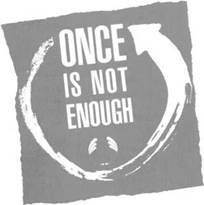
Before you start: Can you explain
the meaning of this logo?
Read the Fact-file
1. In 1990 British consumers threw away 6 million tonnes of paper, 2 million
tonnes of glass and 135 million worth of aluminium.
2. Only 4% of recyclable material is actually recycled.
3. In Britain there is one bottle bank for every 14,000 people. In France and
Germany the figure is one bottle bank for every 2,000.
4. 90% of British rubbish is tipped into landfill sites. There are 5,000 such
landfill sites in Britain today.
5. In 2006, each person in the USA threw away about 4 pounds (1,9 kg) of trash
daily, which is 45,000 trash trucks every day. About 1/3 of this waste comes
from packaging.
Which fact do you find the most surprising? Which situation needs the most
urgent action? Which fact arouses the most optimism?
Fill in each gap with one word
Simply speaking, waste is anything thrown away or released into the environment.
Unfortunately, a lot of waste can end up harming the environment. You can help
protect the environment by learning about and practising the 3 Rs: REDUCE,
RECYCLE and REUSE ! We propose some practical ways of doing this.
CHOOSE TO REUSE . It’s not waste until you waste it! Think carefully about how
you can reuse something before you throw it way. 1) … a compost heap in the
garden with fruit and vegetable material – it will decompose and make good
fertiliser for your plants. Also, if things break, try to repair them before you
replace them. Remember that one man’s rubbish is another man’s treasure! If you
buy a replacement for something you already have, 2) ... the old item to someone
who can use it. Have your jeans got holes in the knees? Make new shorts out of
them or give them to someone who needs them. Don’t throw away empty jars and
bottles; rinse them out and use them to store other things.
TURN IT DOWN OR SWITCH IT OFF. Always switch off the lights when you leave an
empty room, and use light bulbs that ave nergy. You can also switch off the
cooker a few minutes earlier – there will still be 3)… heat to finish cooking
the food. Why not take showers in cooler water and for shorter lengths of time?
Finally, turn down the heating and put on warmer clothes if you’re cold.
BE A MISER WITH YOUR SHOPPING! Only buy what you really need and use all of it.
Thinking about buying something new? Try the 30-day rule – only buy it if you
4).... want it 30 days after you first saw it. At the supermarket, 5) ... buying
things you do not need by writing a shopping list before you go and making sure
you keep to it. Of course, you should also take your own bags to put the
shopping in.
PUT PACKAGING ON A DIET. First things first; buy things with simple packaging
that can easily be recycled. Better still, choose products with no packaging at
all! Secondly, if you are preparing a packed lunch to eat at school, take a
sandwich in a reusable lunchbox, juice in a reusable bottle and a banana, rather
than a sandwich in a plastic bag, or a carton of juice and biscuits which are
each wrapped in silver paper and even more plastic. And finally ... think BIG!
One large box of cereal, for example, uses less packaging than 6) ... smaller
ones and is usually a lot cheaper too!
SAVE ON PAPER. Try to cut down on the amount of paper you use. Use a computer
and proofread your writing on the screen 7)
... you print it out. Use both sides of the paper and then recycle it. Remember
that telephone calls and email messages don’t create paper waste.
GET OTHERS INVOLVED . Last but not 8) …, ncourag your friends to cut down on
waste too! Swap magazines, books and clothes, send them a copy of this
newsletter (on recycled paper, of course!) or start a “Use Less Stuff!” campaign
at your school!
VOCABULARY
stuff – (разг.) дрянь, хлам, “фигня”
to decompose – разлагаться на составные части
to turn down – уменьшать, убавить (свет, газ и т.п.)
to pack – упаковыват
to proofread – читать корректуру, “вычитывать”
to encourage – поощрять, стимулироват
to swap – обмениваться
consumption – потребление
ASSIGNMENTS
I. Complete the sentences with the words in bold from the text.
1. There wasn’t enough water left for her to … the shampoo out of her hair. 2.
Our teachers … us to use recycled paper. 3. Traffic jams … both air and noise
pollution. 4. He … her birthday present in recycled paper. 5. I feel very tired;
I don’t think I have the … to play football this evening. 6. People in our
neighbourhood have started a paper recycling … . 7. My brother likes to … comics
with his friends. 8 When substances …, they break down into different chemicals.
9. She was a wonderful teacher. It will be difficult to … her. 10. They opened
the cage and … the animals.
II. Create 10 sentences of your own with underlined words from the text.
III. Write an essay, illustrating the following sayings:
a) If you are not a part of a decision, you are a part of a problem.
b) Well begun is half done.
IV. Look at the points mentioned about recycling. Which three are the most
important?
RECYCLING
regenerates the environment
r r r r
reduces pollution and litter
reduces acid rain
reduces the need for landfill sites cuts energy costs
generates jobs
engenders a sense of community pride creates profitable industry
provides funds for charity
V. What can YOU do? You are given a list of some practical ideas. Choose
those which, in your opinion, can help to save the environment.
1. Buy fresh food that doesn’t need a lot of packaging.
2. Try to buy organic fruit and vegetables from farmers, who don’t use chemicals.
3. Save as much water as possible.
4. Find out more about Green organizations in your area.
5. Use products that won’t stay forever in earth or sea when you throw them away.
6. Use bottles more than once (or take them to a bottle bank).
7. Try to save paper. Also, buy and use recycled paper as often as possible.
8. Avoid throw-away products.
9. Don’t buy products (fur or ivory, for example), made from rare or protected
species of animals.
10. Use public transport as often as possible.
11. Try to eat healthy products. Avoid too much fat or sugar.
12. Don’t buy hamburgers or pizzas in plastic boxes which contain CFCs.
13. Use batteries as little as possible. It takes 50 times more energy to make
them than they produce.
14. Don’t leave on electric lights, TV, hi-fi, etc, if you are not using them.
15. Try to throw away at least 25% less rubbish.